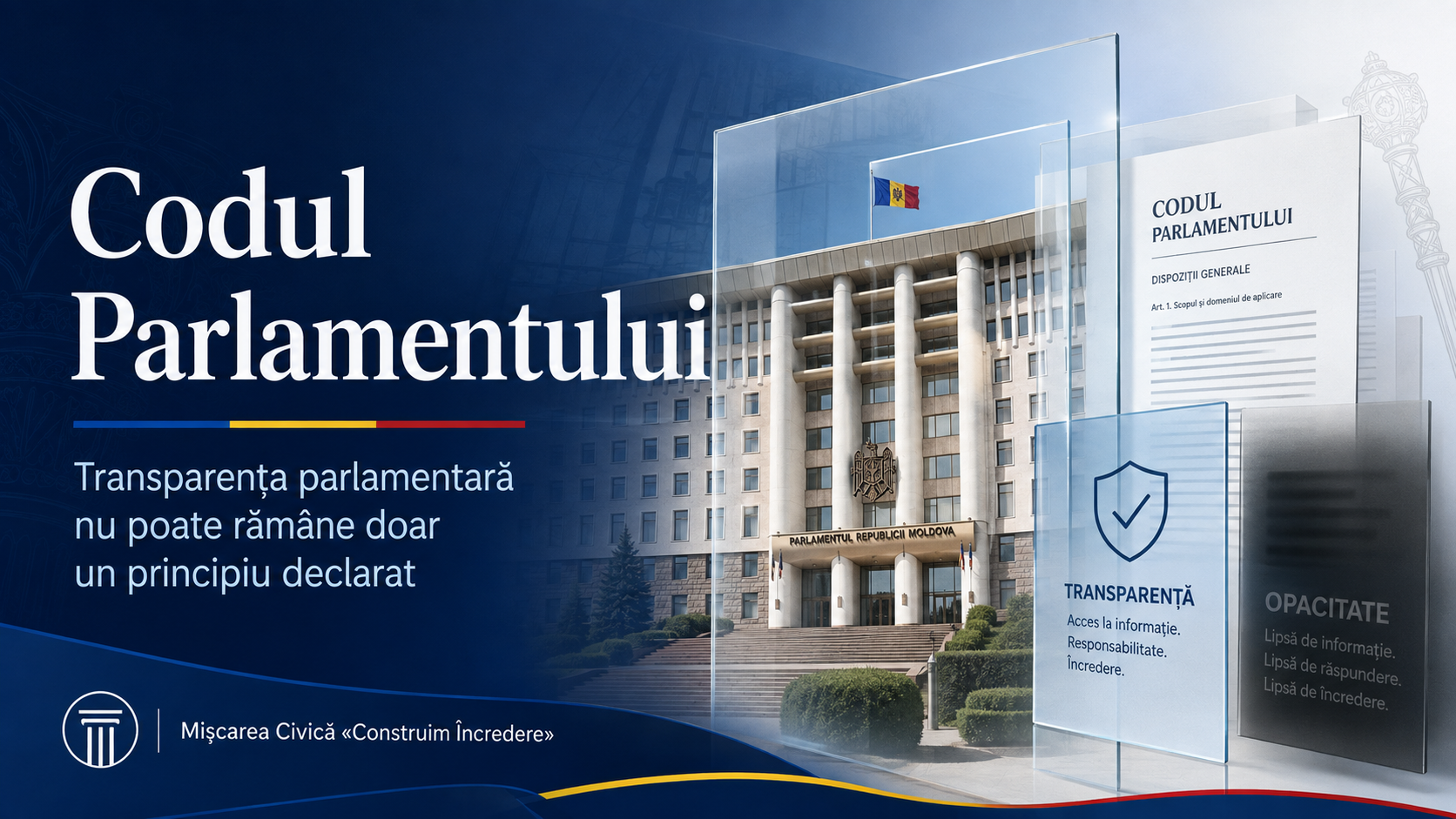
PARLIAMENTARY CODE: How Parliamentary Transparency Was Stripped of Substance
The Civic Movement “Building Trust” analyzed the summary of amendments, proposals and objections to the draft Parliamentary Code, which was voted on in the second reading on 25 August 2026. Our analysis reveals a significant gap between the transparency principles declared in the draft and the concrete mechanisms through which this transparency should be ensured in practice.
Of the 19 proposals submitted by the Civic Movement “Building Trust”, 17 were rejected in full, one was partially accepted, and in only one case was the intended objective achieved through a different amendment. Our proposals were primarily aimed at strengthening parliamentary transparency, public consultations and citizens’ ability to follow the legislative process.
We requested clear minimum deadlines for public consultations, publication of submitted contributions and information on how they were examined, justification for the rejection of recommendations, timely publication of agendas, clearer rules for urgent procedures, and safeguards ensuring the public nature of parliamentary committee meetings.
At the same time, amendments were accepted into the Parliamentary Code that eliminate or weaken some of the transparency mechanisms initially included in the draft. These include the removal of transcripts of committee meetings, mandatory reporting following parliamentary hearings, the recording of the number of votes cast on amendments, and certain safeguards related to public consultation. The prohibition on putting amendments to a vote if they had not previously been discussed by the relevant parliamentary committee was also removed.
The analysis also highlights several contradictions. For example, the requirement to produce transcripts of committee meetings was removed on the grounds that live broadcasts were available, even though the obligation to provide such broadcasts had previously been rejected due to a lack of technical capacity. At the same time, a recommendation aimed at extending public consultation periods resulted, in the adopted version, in their effective shortening.
The fundamental issue is that parliamentary transparency cannot exist merely as a principle. Without clear deadlines, publicly available documents, recorded votes, reporting on the results of hearings, and the ability to follow the decision-making process, citizens cannot effectively verify how and why a particular decision was adopted.
Before the third reading, we call on Parliament to review these provisions and restore the safeguards necessary for a transparent, predictable and verifiable legislative process. Our requests include restoring reporting requirements following hearings, recording votes on amendments, protecting public consultations, limiting last-minute amendments, and ensuring transparency in the work of parliamentary committees.
Transparency does not simply mean being able to see what Parliament is doing. It means being able to understand, follow and verify how decisions are made.