Statement of the Civic Movement on the Practice of Accelerated Consideration and Adoption of a Very Large Number of Legislative Proposals
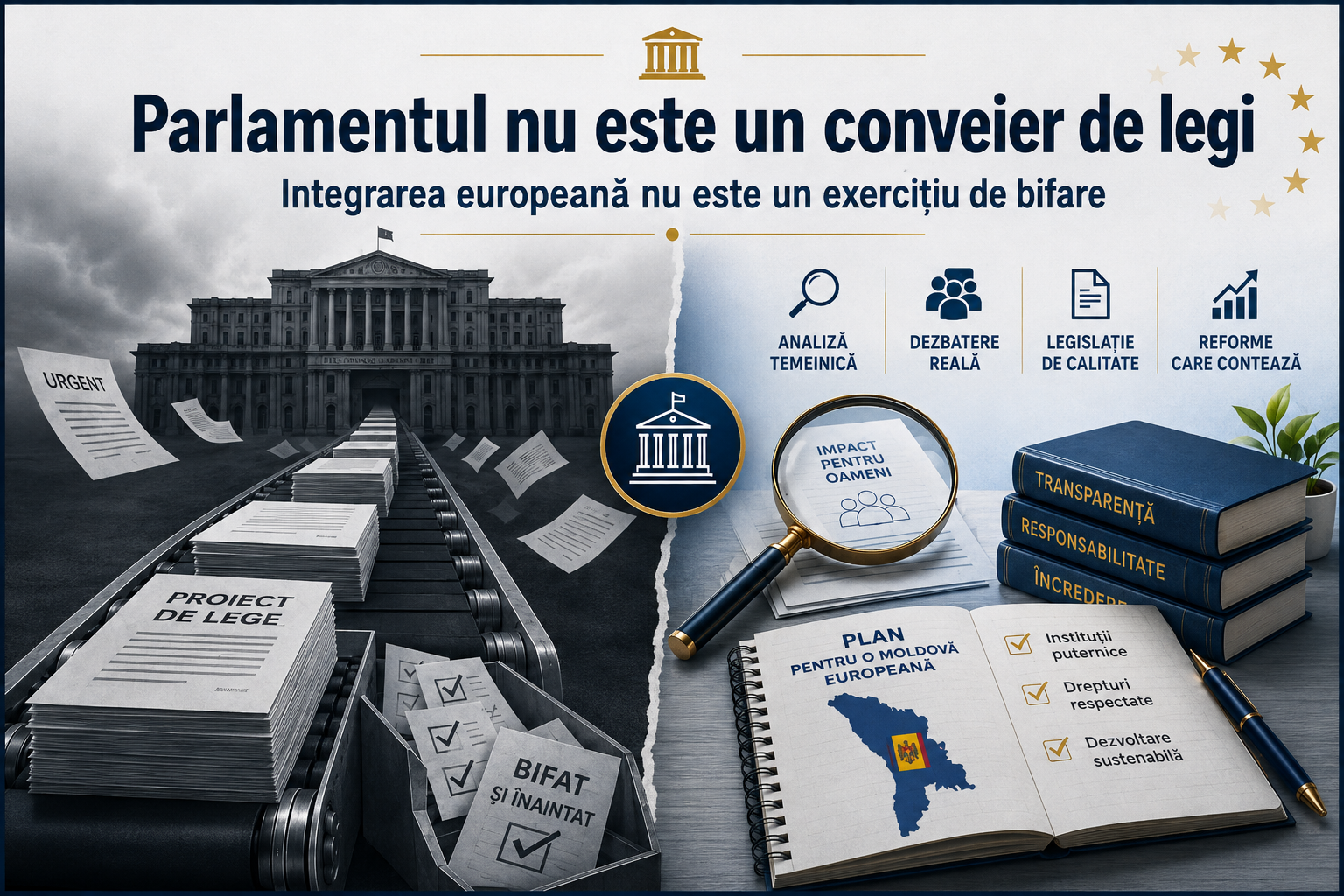
Parliament is not a legislative conveyor belt, and European integration is not a box-ticking exercise.
The Civic Movement “Building Trust” draws attention to the practice of rushing through the consideration and adoption of a large number of legislative proposals without sufficient time for analysis, debate and assessment of their consequences.
European integration requires the harmonisation of legislation with EU standards, but transposing a rule does not automatically mean that institutions and society are ready to implement it. Laws must be adapted to the realities of the Republic of Moldova, assessed in terms of their impact on citizens and the economy, and supported by adequate resources and clear implementation mechanisms.
We call on Parliament and the Government to ensure greater transparency, meaningful time for the examination of major reforms, credible impact assessments and verification of whether institutions actually have the capacity to put the new rules into practice.
The Republic of Moldova needs fewer legislative improvisations and more quality, predictability and public accountability.
European integration is not measured by the number of laws adopted or boxes ticked, but by the results these reforms deliver for people.
The full statement is available below.
Statement of the Civic Movement “BUILDING TRUST”
Parliament is not a legislative conveyor belt, and European integration is not a box-ticking exercise
The Civic Movement “Building Trust” expresses its concern regarding the practice of accelerating the consideration and adoption of a very large number of legislative proposals, including during extraordinary sittings of Parliament.
An effective Parliament is not one that adopts the greatest number of laws in a single day, but one that adopts laws that are clear, well-founded, enforceable and sustainable.
When dozens of proposals are placed on the same agenda and the time allocated for presentations, questions, debates and consideration of amendments is reduced to a minimum, the parliamentary process risks turning into a mere legislative conveyor belt. Draft laws are voted on, indicators are reported, and afterwards society as a whole is expected to bear the consequences of legislative blunders.
The discussions generated by the citizenship law, as well as by certain provisions of the draft tax reform — including those concerning inheritances and the tax obligations of non-residents — demonstrate how important impact assessment, clarity of legal provisions and verification of their practical enforceability truly are.
It is not sufficient for the authorities, once problems have emerged, to acknowledge that certain omissions occurred and promise to correct them. Citizens, businesses and public institutions must not be turned into involuntary participants in legislative experiments.
This approach is all the more dangerous in the context of European integration.
The Republic of Moldova has an obligation to harmonise its legislation with the acquis of the European Union. However, European integration must not be reduced to an administrative competition in which we report how many directives and regulations have been transposed and how many boxes have been ticked.
Transposed does not automatically mean ready for implementation.
A European rule must be assessed against the realities of the Republic of Moldova, the capacity of its institutions, the available financial and human resources, the preparedness of the authorities, and the effects it will have on citizens and the economy.
Rushed transposition, without assessing implementation capacity, may generate administrative bottlenecks, unjustified costs, contradictory interpretations, obligations that are impossible to comply with, and overregulation. Instead of obtaining more efficient institutions and better public services, we risk building even more complicated procedures, placing additional burdens on citizens and businesses, and undermining the very objectives of the reform.
European integration does not mean mechanical copying. It means adopting principles and standards and transforming them into solutions that are functional, proportionate and feasible for the Republic of Moldova.
We therefore call on Parliament and the Government:
to ensure meaningful time for the examination of proposals with major impact;
to publish draft laws, amendments, opinions and summaries of consultations well in advance;
not to promote legislation before receiving and examining the opinions of the competent institutions, including European institutions, where such opinions have been requested;
to present, for every major reform, a credible impact assessment and a concrete implementation plan;
to verify whether the responsible institutions have sufficient staff, expertise, information systems and financial resources to implement the new obligations;
to provide for transition periods, testing mechanisms and subsequent evaluations so that deficiencies can be corrected before they cause harm;
to abandon the practice of repeatedly repairing laws that were adopted in haste.
The parliamentary majority has enough votes to pass a proposal. But votes cannot replace arguments, analysis and responsibility.
Not every law adopted quickly is a reform. Not every rule labelled “European” automatically produces European outcomes.
The Republic of Moldova needs fewer legislative improvisations and more quality, predictability and public accountability.
Europe does not ask us to adopt laws on a conveyor belt. Europe asks us to build institutions capable of implementing the law, protecting people’s rights and delivering results.
And this is demonstrated not by the number of boxes ticked, but by the quality of citizens’ lives after the law enters into force.
Civic Movement “Building Trust”