
POSITION PAPER. Livada Moldovei II
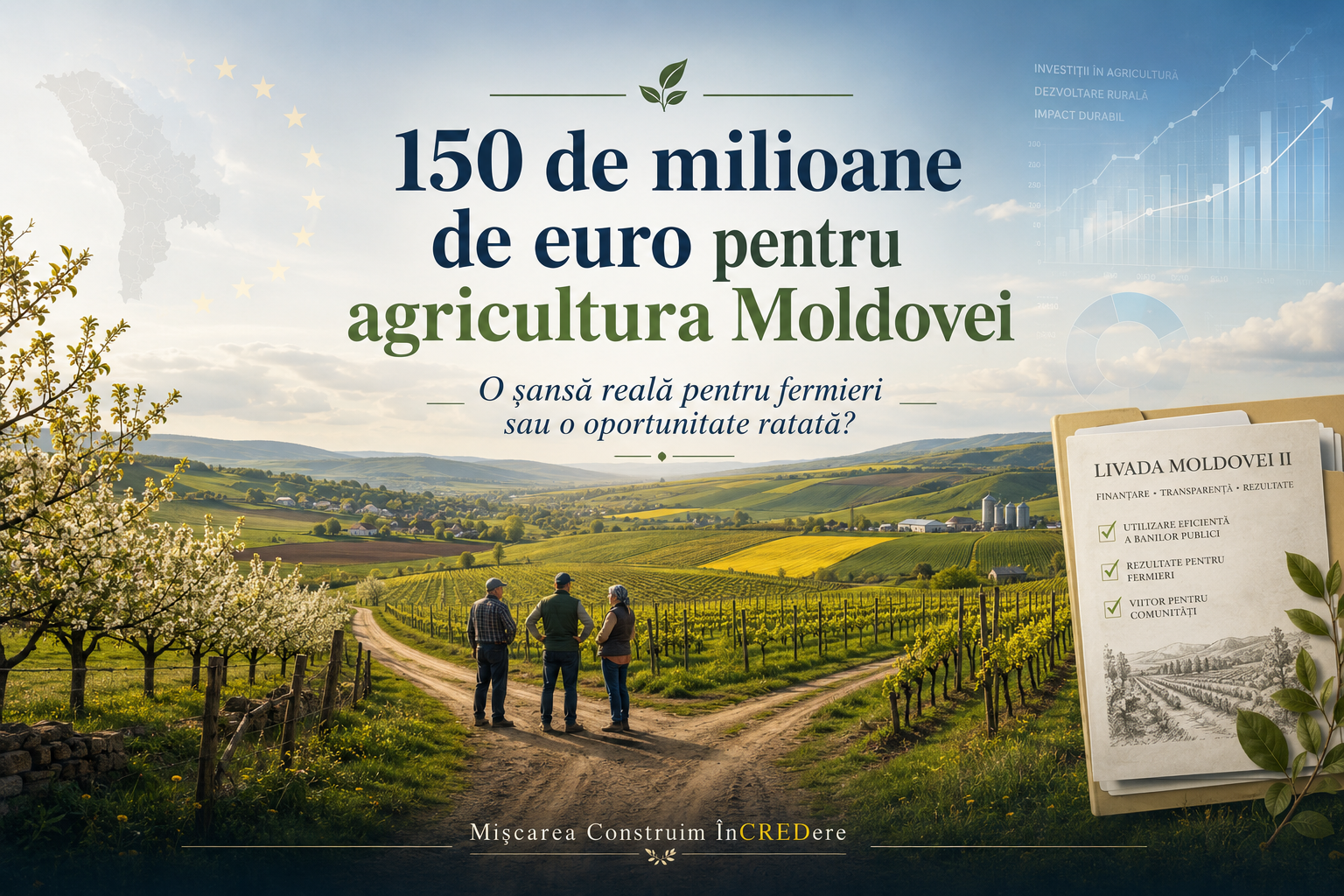
€150 million for Moldova’s agriculture. A real opportunity for farmers or a missed chance?
The Construim ÎnCREDere Movement supports the mobilisation of European financing for the development of the Republic of Moldova’s agricultural sector and believes that “Livada Moldovei II”, financed through a €150 million loan from the European Investment Bank, can become an important instrument for modernising the agri-food sector, developing rural businesses and increasing the competitiveness of Moldovan producers.
But precisely because we are speaking about €150 million borrowed on behalf of the Republic of Moldova and which will have to be repaid, the success of the project cannot be measured merely by whether the funds have been disbursed or “absorbed”.
The essential question is different: who will actually benefit from this financing, and what concrete economic results will it generate?
The experience of “Livada Moldovei I” must be carefully examined before the new phase becomes operational. The Court of Accounts previously identified issues relating to the institutional framework, planning, monitoring, resource management and certain internal procedures. These findings do not mean that the project failed to produce results, but they clearly show that the new phase must be built on stronger safeguards for transparency, competition and oversight.
One of our main concerns is the effective access of small farmers, family farms, young farmers, micro-enterprises and newly established businesses to financing.
During the first phase, access to financing required a significant contribution from the beneficiary, sufficient collateral, a banking track record and the ability to pass the screening procedures of financial institutions. These requirements are much easier for an already well-capitalised company to meet. For a farmer who is only starting out or for a small rural business, they can become a genuine barrier.
The publicly available data we analysed also do not provide a sufficiently clear picture of how financing under the first phase was distributed among micro-enterprises, small and medium-sized enterprises and newly established businesses. This is precisely why, under “Livada Moldovei II”, these categories should be monitored and reported separately.
There is also the issue of repeat beneficiaries. During the first phase, some companies accessed financing several times, including for a fifth or sixth project. This is not, in itself, an irregularity. A successful company may legitimately require several stages of investment.
The problem arises when there is insufficient transparency regarding the cumulative amount of financing received by each beneficiary and by groups of affiliated enterprises. Without such monitoring, there is a risk that a disproportionate share of resources will repeatedly go to companies that are already bankable, while new beneficiaries face difficulties entering the programme.
Another important lesson concerns financial intermediaries.
Several financial institutions participated in “Livada Moldovei I”, but our analysis indicates a significant concentration of the portfolio among a small number of intermediaries. The number of banks formally admitted to the programme is not sufficient, by itself, to demonstrate that genuine competition exists.
For a farmer, what matters is what reaches them in practice:
🔹 the interest rate they will pay;
🔹 the margin charged by the bank;
🔹 the fees applied;
🔹 the collateral required;
🔹 the total cost of the loan.
There should therefore be transparent reporting on the entire flow of funds — from the cost of the financing provided by the EIB to the actual cost ultimately borne by the final beneficiary.
The analysis of the first phase also highlights the important role played by Business Development Services (BDS) companies in preparing investment applications. The fact that a very high proportion of applications required assistance from consultants demonstrates both the usefulness of technical assistance and the complexity of the procedures involved.
The new project should avoid any situation in which access to financing becomes, in practice, dependent on a narrow circle of consultants. If such a mechanism is used again, the selection of service providers must be transparent and competitive, while advisory functions must be clearly separated from decisions regarding the eligibility of beneficiaries.
Another essential issue is how the rules governing the project will be established.
During the first phase, the Operational Manual and the Side Letter played an important role in setting the terms under which the programme operated. Under “Livada Moldovei II”, the fundamental criteria — who may benefit, the financing limits, the required level of co-financing, the conditions that may lead to exclusion and the treatment of affiliated beneficiaries — must have a clear legal basis and must not be subject to changes through administrative procedures that are difficult for the public to track.
For these reasons, the Construim ÎnCREDere Movement calls for:
🔹 publication of the draft Operational Manual before its approval;
🔹 consultation of the document with farmers, professional organisations, the business community and civil society;
🔹 publication of the Financing Contract with the EIB and the annexes relevant to implementation, within the limits established by law;
🔹 public, objective and non-discriminatory criteria for the selection of financial intermediaries;
🔹 reporting on the number of unique and repeat beneficiaries, as well as cumulative financing per beneficiary and affiliated group;
🔹 separate reporting for micro-enterprises, SMEs, start-ups, family farms and young farmers;
🔹 consideration of guarantee instruments or differentiated co-financing arrangements for viable businesses that do not have sufficient collateral or capital;
🔹 clear procedures for providing reasons for and appealing eligibility decisions;
🔹 periodic financial audits and public reporting on project performance;
🔹 an independent Mid-Term Review before any extension or major modification of the project;
🔹 public disclosure of how the recommendations made by the Court of Accounts following “Livada Moldovei I” have been implemented.
The authorities should also clearly explain how the €150 million will be allocated: how much will go towards enterprise financing, how much towards public investment, how much towards technical assistance and administration, and what additional public resources will be required to implement the project.
Because success should not be measured merely in millions of euros spent.
Success should be measured by:
🌱 how many small farms have been able to grow;
🏡 how many new businesses have been created in rural areas;
👨🌾 how many young people have been able to start an agricultural activity;
💼 how many jobs have been created in villages;
🏭 how much value-added processing capacity has been developed;
🇪🇺 how many Moldovan producers have become more competitive and gained easier access to external markets.
We do not want “Livada Moldovei II” to be blocked. We want it to be well designed and properly implemented.
€150 million represents a major opportunity for the agricultural sector of the Republic of Moldova. But this opportunity will only have real value if the rules are clear, access is fair, the funds are managed transparently and the results are measured by the tangible change they create in the economy and in rural communities.
Financing must remain accessible to competitive enterprises, while at the same time providing a genuine opportunity for those that currently lack sufficient capital to take the next step towards investment, growth and exports.