Beyond Milestones: Reforms Must Be Assessed by What They Change in Citizens’ Lives
In the context of the Republic of Moldova–European Union Association Council meeting of 5 October 2026, the Civic Movement “Construim Încredere” prepared the Declaration “Beyond Milestones: What Reforms Reveal in the Lives of the Citizens of the Republic of Moldova.”
The Republic of Moldova is at an important stage of its European path. The opening of negotiations on Clusters 1 and 6, progress on the Reform Agenda, and the support provided through the Growth Plan confirm genuine institutional convergence with the European Union.
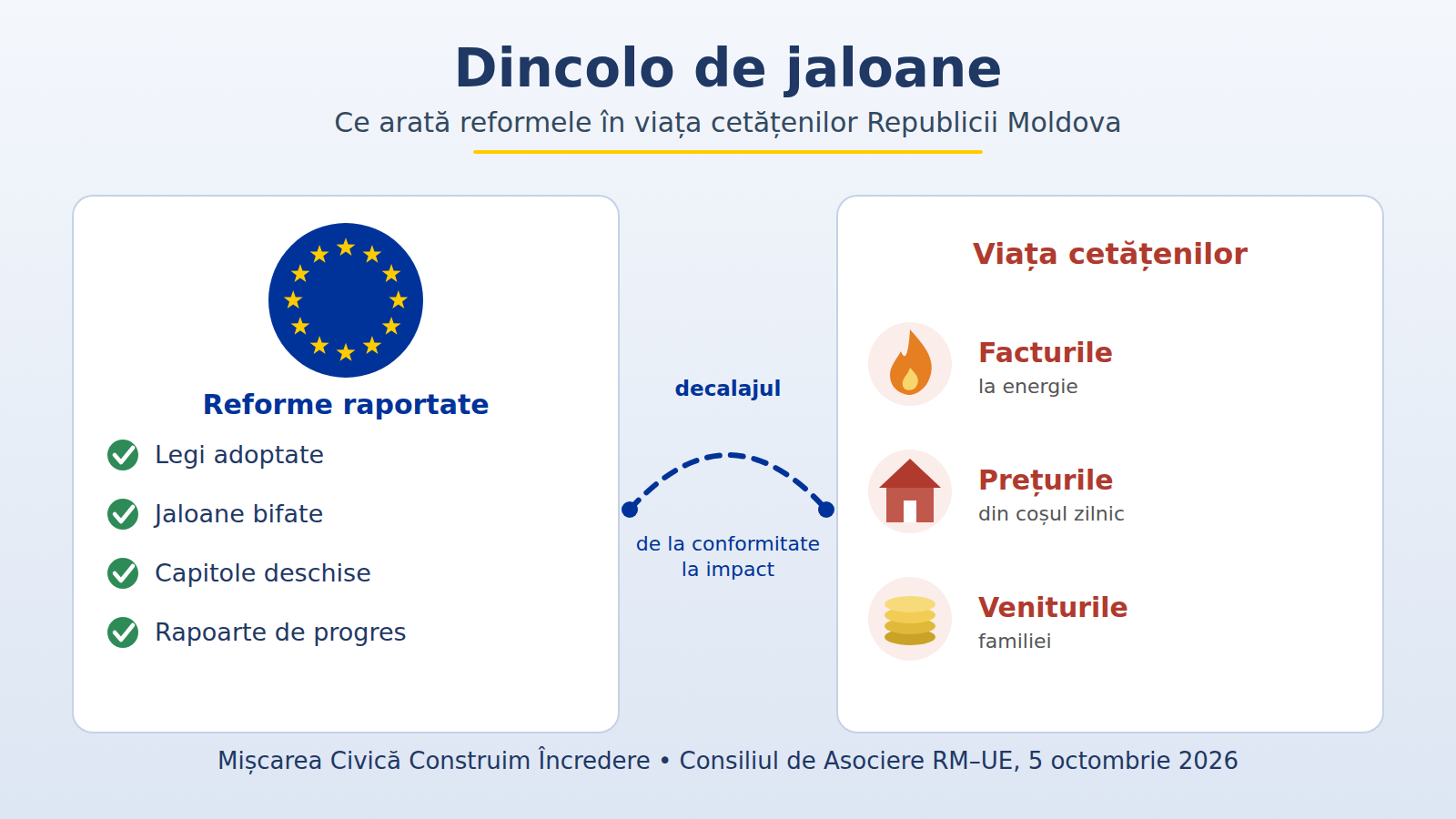
The Civic Movement “Construim Încredere” supports this direction, but considers that the progress achieved so far requires a more mature assessment of the next stage. It is no longer sufficient to look only at what legislation has been adopted, which milestones have been fulfilled, or which negotiation chapters have been opened. We must also examine what these reforms actually change in the functioning of the state and in people’s lives.
The issue we are highlighting is not the absence of reforms, but the gap between reported reform and experienced reform. Citizens assess the state through very concrete realities: how much they pay for energy, how much of their income remains after price increases, how accessible public services are, whether the administration listens to them, whether positions are filled on merit, and whether public money produces visible results.
The analyses carried out by the Movement in 2026 repeatedly pointed to the same vulnerability: the existence of a procedure or the adoption of a measure does not, in itself, guarantee the quality of the outcome. In “Governance under Review”, the monitoring of 325 sectoral commitments showed that a significant share of them had been formulated without sufficient measurable benchmarks to allow their results to be objectively verified.
The same issue was observed in the amalgamation process, in amendments to the Electoral Code, and in the analysis of the Parliamentary Code, where the Movement drew attention to the difference between the formal existence of consultation and citizens’ actual influence over decision-making. The functioning of democratic institutions must be assessed not only through the final act adopted, but also through the quality of the decision-making process.
In public administration reform, the reorganisation of an institution or the creation of a new structure does not, by itself, represent an increase in state capacity. Reform becomes real when institutions become more competent, services improve, responsibilities become clearer, and leadership is held accountable for results. For this reason, meritocracy, transparency in appointments, and linking responsibility to performance must remain central criteria.
The EUR 1.9 billion Growth Plan represents a significant opportunity for the Republic of Moldova. Approximately EUR 504 million has already been unlocked. However, the fulfilment of a milestone should not be treated as the end of a reform, but as the beginning of assessing its actual results.
For the Movement, the essential question is: what new economic, institutional, and social capacity does the mobilised resource create?
This question is all the more important because the largest share of the Facility consists of concessional loans. Therefore, every euro received or borrowed should be traceable through a clear and public pathway: reform – financing – project – beneficiary – result – impact.
The data presented in the Declaration also illustrate the scale of the challenge. Economic growth stood at 0.6% in the first half of 2026, while the absolute poverty rate for 2025 was 31.1%, reaching 40% in rural areas. At the same time, pressure on households is accumulating through inflation, energy costs, and fiscal changes.
Across the country, the Republic of Moldova continues to lose population, while rural poverty remains almost twice as high as urban poverty. For this reason, administrative-territorial reform cannot be assessed solely by the size of the new administrative units. A larger municipality does not automatically create jobs, services, transport, investment, or reasons for young people to stay.
European integration will become convincing for local communities when it reduces not only the distance between Chișinău and Brussels, but also the distance between Chișinău and the rest of the country.
Agriculture represents another major test. Administrative compatibility with the Common Agricultural Policy is not enough if Moldovan producers do not also acquire the economic capacity to compete on the European market. Farmers must be able to bear the costs of compliance and have access to advisory services, credit, irrigation, processing facilities, and markets. The success of the PSPA and European funding should not be measured only by the amount of subsidies distributed, but by productivity, agricultural income, climate resilience, processing capacity, and competitiveness.
The Movement considers that civil society has an important role in assessing this gap between reform and results. Participation should not end with consultation on a draft law. Independent organisations must be able to monitor implementation and have access to data, reports, indicators, audits, and information regarding project beneficiaries and outcomes.
A European civil society is not called upon to automatically applaud every reform, but to verify whether it produces the result for which it was adopted. Evidence-based criticism is not the opposite of European integration; it can make the process more credible, more effective, and more beneficial for citizens.
In the Declaration, the Movement also proposes an essential intermediate stage in assessing progress: before measuring the impact of a reform, it is necessary to examine whether the adopted legislation genuinely complies with European standards and the EU acquis, whether the drafting process was transparent and based on genuine public consultations, and whether the principles of the rule of law, good governance, democratic participation, transparency, and institutional accountability were respected.
The message addressed to the Association Council is therefore clear: the next stage of the accession process should place greater weight both on the quality and democratic legitimacy of reforms and on their real impact on institutions, the economy, communities, and citizens’ standard of living.
The Republic of Moldova needs an acceleration of European integration, but also a comparable acceleration in the quality of governance, economic capacity, and results that citizens can actually feel.
The full Declaration, “Beyond Milestones: What Reforms Reveal in the Lives of the Citizens of the Republic of Moldova”, is available in the attached document.