

Statement on the Draft Fiscal and Customs Policy for 2027
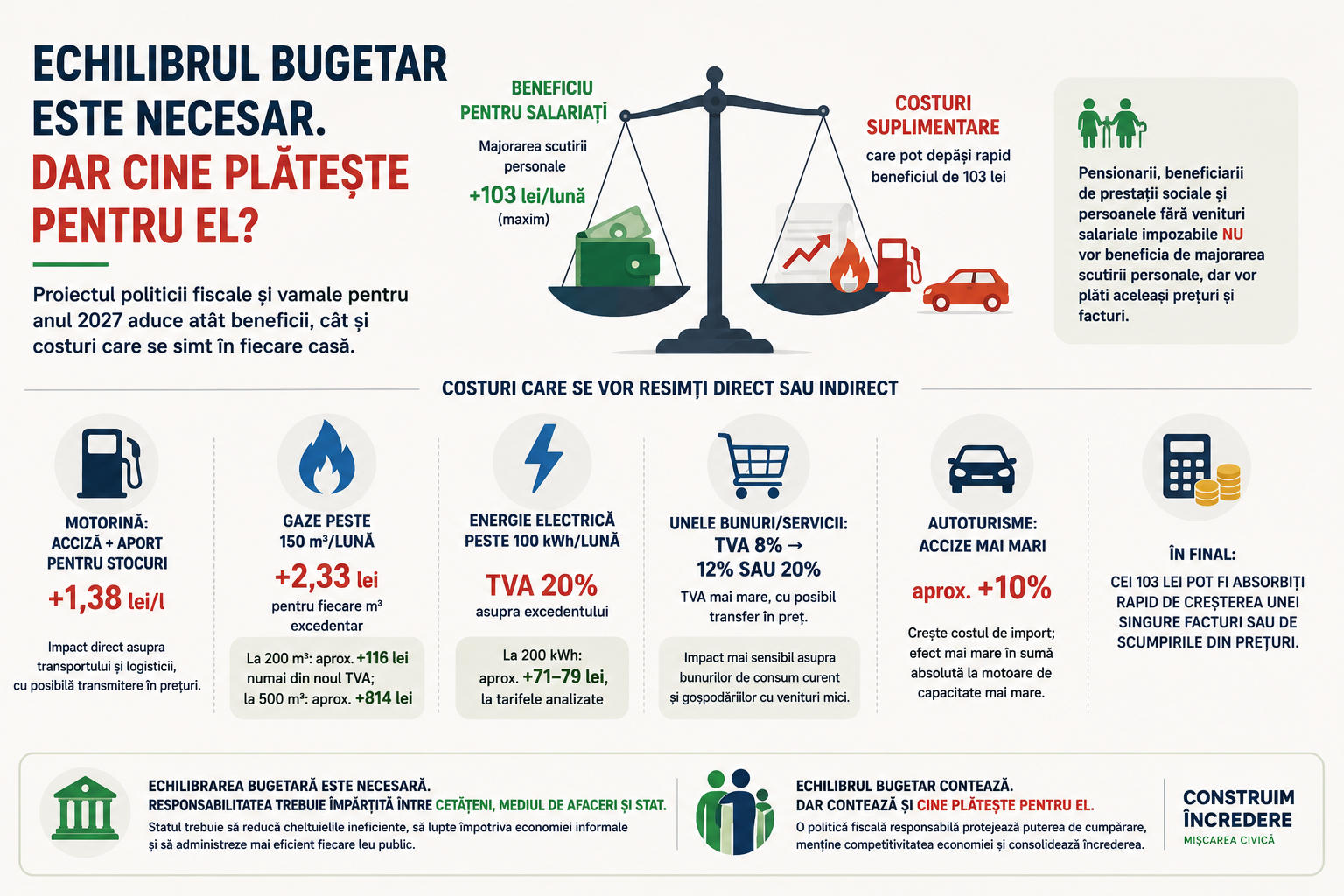
Budget balance is necessary. But who pays for it?
The Civic Movement “Building Trust” has analysed the draft Fiscal and Customs Policy for 2027 and draws attention to the cumulative impact that the new measures may have on the population and the economy.
The Movement acknowledges the need to strengthen public finances and supports a number of measures included in the draft, including the increase in the personal tax allowance, a higher fiscal contribution from the financial sector, the reimbursement of a significant part of the excise duty on diesel used in agriculture, and the establishment of strategic reserves. However, it considers that the draft focuses primarily on identifying additional sources of budget revenue, while the component aimed at stimulating economic development remains less visible.
According to calculations presented by the Movement, increasing the personal tax allowance from MDL 29,700 to MDL 40,000 would provide an employee with a maximum tax benefit of approximately MDL 103 per month. At the same time, the draft includes measures that may generate additional costs: approximately +MDL 1.38 per litre of diesel, around +MDL 116 for gas consumption of 200 m³, and approximately +MDL 71–79 for electricity consumption of 200 kWh. For certain goods and services, VAT would increase from 8% to 12% or 20%, while excise duties on passenger cars would rise by approximately 10%.
The Movement also draws attention to the social dimension of the reform. Pensioners, recipients of social benefits, unemployed persons and other people without taxable employment income will not benefit from the increase in the personal tax allowance, yet they will still feel the effects of higher prices and additional costs passed on through energy, transport and logistics.
In this context, “Building Trust” calls on the Government to provide a clearer explanation of the causes of the budget deficit and the measures it intends to take to reduce inefficient expenditure, improve public procurement, combat the informal economy and increase the efficiency of revenue collection.
The Movement believes that credible fiscal consolidation must involve responsibility on the part of citizens, the business community and the state, and that the burden of adjustment should not be transferred disproportionately onto the population and the economy.
Budget balance is important, but equally important is how we achieve it and who bears the cost of that balance. A responsible fiscal policy must protect purchasing power, maintain the competitiveness of the economy and strengthen trust between the state and the taxpayer.
Full text below: