

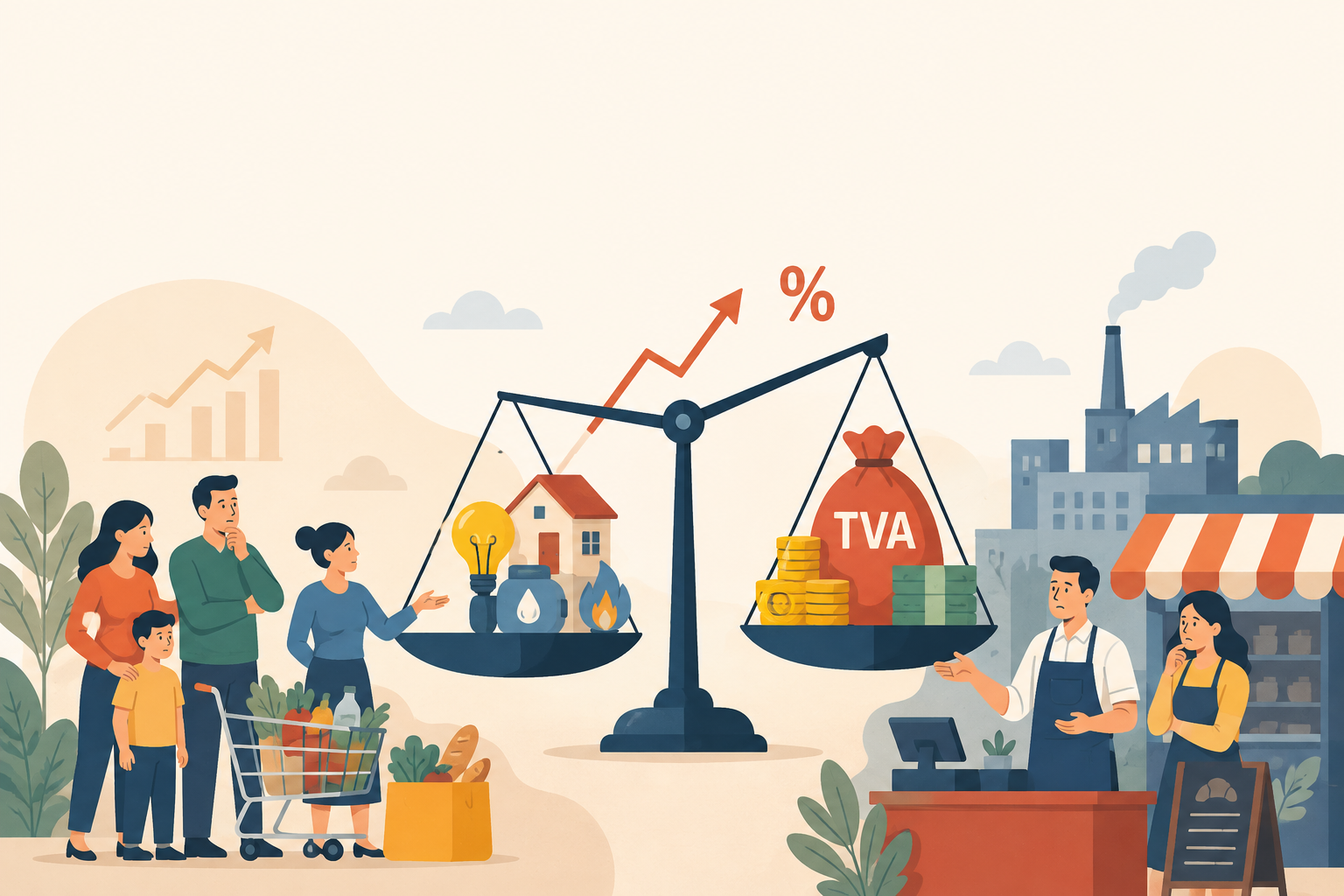
Statement of the Civic Movement “Building Trust” on the VAT Amendments Proposed for 2027
The Civic Movement “Building Trust” has analysed the VAT-related amendments proposed in the draft Fiscal Policy for 2027 and the impact they may have on citizens, businesses and the economy of the Republic of Moldova.
Tax reform is not only about rates, percentages and additional budget revenues. It is also about what kind of economy we want to build, what we encourage businesses to produce and invest in, and how we distribute the tax burden between the state, the economy and citizens.
In their current form, several of the proposed amendments essentially mean more VAT: from 8% to 12%, from 8% to 20%, and in certain cases even from 0% to 20%.
And VAT does not remain confined to a table. Ultimately, it may be reflected in prices, utility bills and household budgets.
🔹 Food products – some agricultural products would move from an 8% VAT rate to 12%, while certain everyday consumer goods could become subject to the standard 20% rate. For products moving from 8% to 20%, if the pre-VAT price remains unchanged, the final price may increase by approximately 11.1%.
🔹 HoReCa and accommodation services – VAT would increase from 8% to 12%. This creates additional pressure on a sector largely made up of small and medium-sized enterprises and one that contributes directly to tourism development.
🔹 Electricity – the 0% rate would be maintained only for the first 100 kWh consumed each month, while consumption above that threshold would be taxed at 20%. The same threshold, however, would apply both to a person living alone and to a large family.
🔹 Natural gas – the reduced rate would remain applicable to the first 150 m³ consumed each month, while additional consumption would be taxed at 20%. Such a mechanism does not take into account the number of people in a household, the size and energy efficiency of the dwelling, or the fact that gas needs increase significantly during the winter months.
🔹 Businesses and producers – higher VAT on energy resources may increase working-capital needs and, in certain circumstances, create additional costs. Exposed sectors include food processing, bakeries, greenhouses, HoReCa and small-scale production facilities.
🔹 Recycling and the circular economy – the draft provides for the removal of certain VAT incentives for machinery and equipment used in waste collection and recycling. We believe that investments required for the transition to a circular economy should be encouraged, not made more difficult to finance.
🔹 Online shopping – for parcels worth up to EUR 150 ordered by individuals from foreign online platforms, the proposal provides for the application of VAT, generally at 20%, as well as a fixed handling fee of MDL 12 per parcel. For small orders, the percentage impact may become significant.
The Republic of Moldova needs budget revenues. But tax reform must do more than collect money. It must contribute to economic development, investment incentives, protection of purchasing power, and maintaining the competitiveness of businesses and producers.
For this reason, the Civic Movement “Building Trust” calls for the VAT-related amendments to be reviewed before they are advanced in Parliament, as well as for a transparent assessment of their impact on households, small businesses, agriculture, the food industry, HoReCa and energy-intensive sectors.
We also consider it necessary to recalibrate the thresholds for gas and electricity, reassess the move of certain everyday food products to the 20% VAT rate, and preserve incentives for investments in the circular economy.
📄 Below you can find the full text of the Statement of the Civic Movement “Building Trust”, as well as the fiscal policy analysis underpinning this position.
It is not enough to know how much additional revenue the state will collect.
People have the right to know how much it will cost them.