

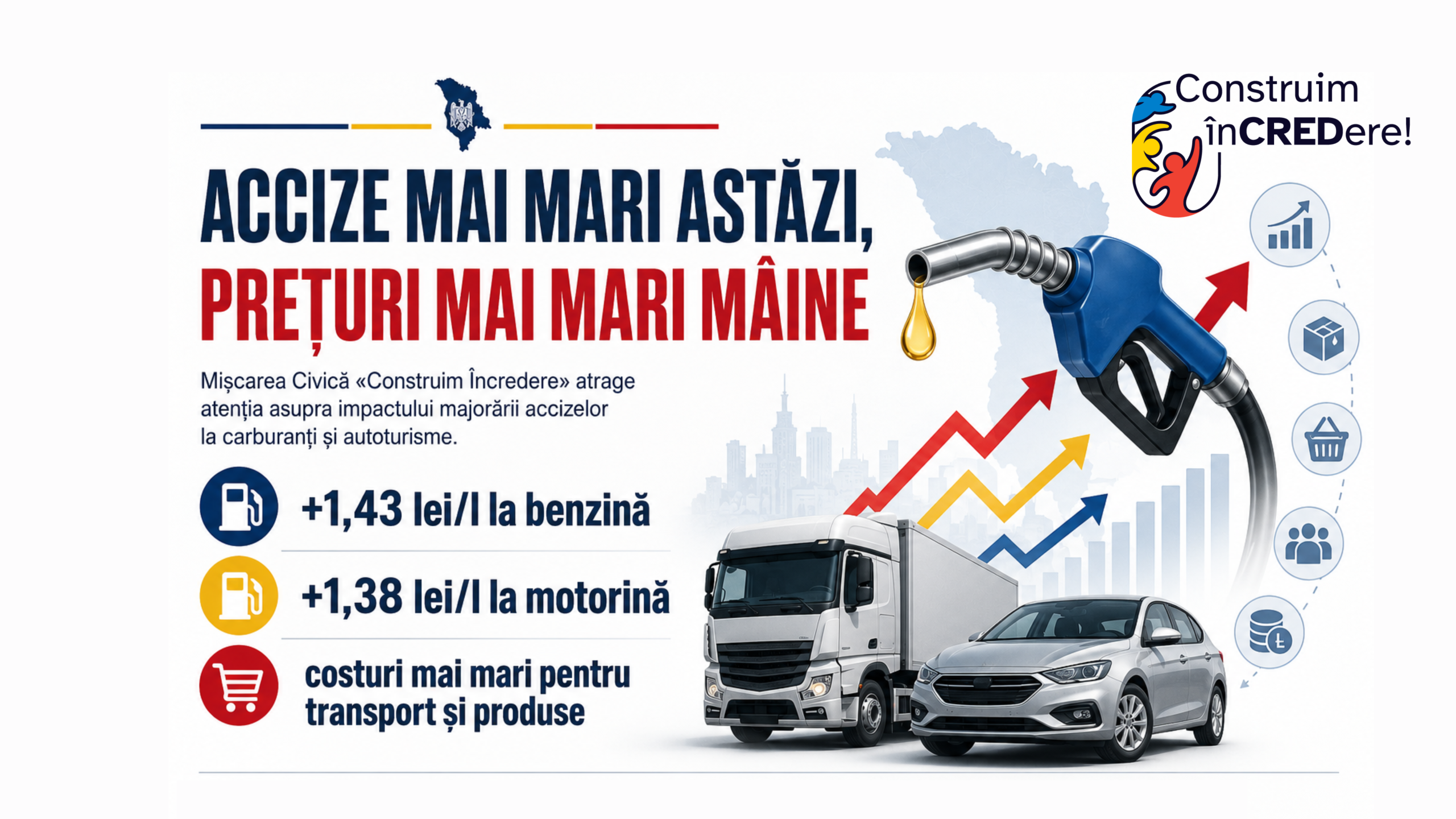
Statement on the Proposed Excise Duty Changes for 2027
HIGHER EXCISE DUTIES TODAY, HIGHER PRICES TOMORROW
The Civic Movement “Construim Încredere” draws attention to the effects that the proposed changes to excise duties for 2027 may have on the economy and on the costs ultimately borne by citizens.
The Republic of Moldova needs a predictable fiscal policy and gradual alignment with European Union standards. However, fiscal harmonisation cannot simply mean higher taxes introduced at a pace whose effects will be felt immediately by both the economy and the population.
According to the draft fiscal policy for 2027, the excise duty on petrol is set to increase by 10%, while the excise duty on diesel is set to increase by 20%. At the same time, fuel prices will also include a contribution of MDL 0.48 per litre for the creation and maintenance of emergency stocks.
Taken together, these measures could result in an increase of approximately MDL 1.43 per litre of petrol and MDL 1.38 per litre of diesel, including the VAT effect.
However, the problem does not end at the petrol station.
Diesel is one of the main cost components of road freight transport. An increase in diesel prices may be passed on to logistics costs and, subsequently, to the prices of food, medicines, construction materials, agricultural products, imported goods and other widely consumed products.
At the same time, the draft also provides for an approximately 10% increase in excise duties on passenger cars.
A particular issue arises in the case of plug-in hybrid vehicles, where the excise duty reduction is expected to decrease from 50% to 25%.
In the example analysed, for a petrol plug-in hybrid vehicle with a 2,000 cm³ engine, the effective excise duty could increase from MDL 18,900 to MDL 31,185 — an increase of approximately 65%.
We consider the objective of alignment with European standards to be legitimate. However, the pace and timing of these increases must be assessed against the real capacity of the economy and the population to absorb these costs.
For this reason, the Civic Movement “Construim Încredere” calls for:
🔹 a reassessment of the pace of excise duty increases on fuel and the gradual phasing-in of these increases;
🔹 linking such increases to the actual evolution of fuel prices at the pump and allowing for their moderation during periods of external shocks;
🔹 consideration of temporary and targeted measures for sectors in which fuel represents a major cost component, particularly road freight transport;
🔹 temporary retention of the 50% incentive for plug-in hybrid vehicles or a gradual reduction of this benefit.
The Republic of Moldova needs budget revenues. But these revenues are paid for by the economy and, ultimately, by people.
A responsible fiscal policy should not ask only how much more the state can collect, but also how much more the economy can bear.