

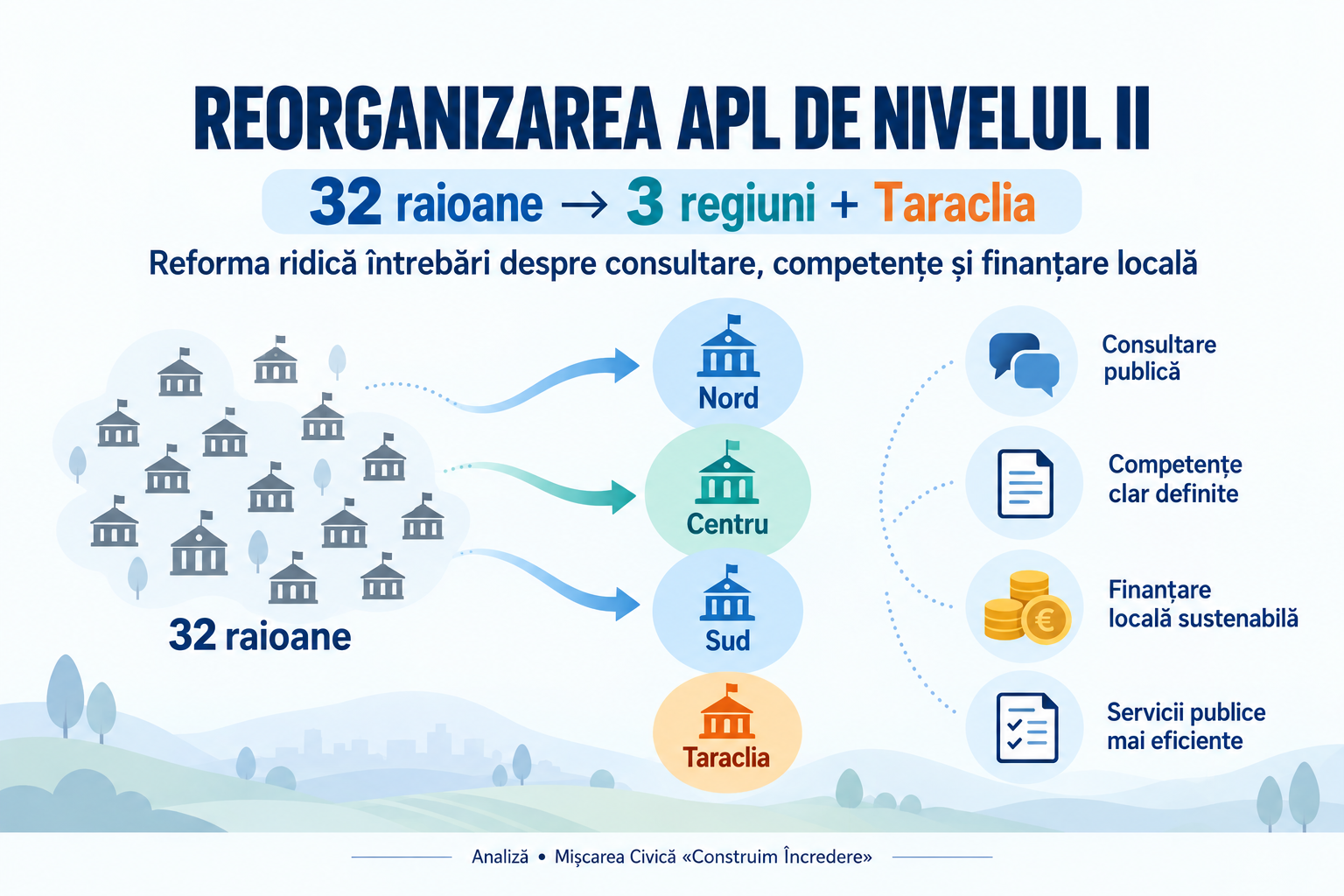
Concept for the Reorganisation of Second-Tier Local Public Administration
The Civic Movement “Construim Încredere” has analysed the Government’s concept for the reorganisation of second-tier local public administration and has prepared an analytical note dedicated to the proposed reform.
The document starts from the premise that administrative-territorial reform is necessary. However, a change of such magnitude cannot be reduced merely to redrawing the administrative map.
In the version presented on 1 October 2026, the concept proposes replacing the 32 districts with three administrative regions — North, Centre and South — and the municipality of Taraclia as a second-tier administrative unit, while Chișinău, Bălți and the Autonomous Territorial Unit of Gagauzia would retain their current status.
Our analysis shows that the main issue is not only how quickly the reform is implemented, but also in what sequence, on the basis of what arguments, and with what consequences for local communities.
The model of second-tier administration has changed substantially within just a few months. From the option of up to ten consolidated structures presented in the spring, the proposal has shifted to three regions, without the new model undergoing a broad process of public consultation. At the same time, the legislative package is expected to be submitted to Parliament in the very same month in which the new concept was presented.
We believe that an administrative reform should not be designed from the map towards the competences. At present, the territorial structure is expected to be established before the exact responsibilities, financing arrangements and accountability of the new regions have been clarified.
This raises a fundamental question: what will citizens be voting for in 2027 if it is still unclear what powers, resources and responsibilities the institutions they elect will actually have?
The analytical note also highlights a fundamental issue in the proposed institutional architecture. Regional councils would be directly elected, giving them significant democratic legitimacy, yet the concept does not currently assign them a clear set of mandatory competences of their own.
At the same time, there is a risk of overlap with the Regional Development Agencies and with existing regional structures. A directly elected level of administration must have not only electoral legitimacy, but also genuine decision-making powers, resources and public accountability.
There is also a contradiction between the stated objective of bringing government closer to citizens and the actual transfer of competences. A significant share of the services currently managed at district level — including education, social assistance, primary healthcare, archives and other administrative functions — would be transferred to ministries and central government agencies.
At the level of mayoralties, mainly certain cultural and youth institutions and other local services would be transferred. The reform should therefore also be assessed from the perspective of the risk of recentralisation, rather than solely in terms of reducing the number of districts.
A significant chapter of the analytical note is dedicated to fiscal decentralisation.
We cannot speak of “strong mayoralties” if they continue to depend largely on transfers from the state budget. According to the data analysed, own-source revenues account for approximately 11% of mayoralties’ revenues, while more than 60% come from transfers.
A larger local administration does not automatically become more financially autonomous. If territorial reform is not accompanied by stronger own-source revenues and clear financing rules, the new structures will remain dependent on the central government.
The document also examines the compatibility of the reform with the principles of the European Charter of Local Self-Government, including the obligation to consult local authorities and communities in due time, the need for genuine competences, and the provision of financial resources proportionate to the responsibilities assigned.
At the same time, the analysis does not reject the overall direction of the reform.
It also identifies positive elements: maintaining services within local communities, transferring assets intended for local service provision to the first tier of local government, avoiding excessive concentration of infrastructure in regional centres, and bringing the proposed structure closer to the parameters used in European cohesion policy.
The issue is that these elements must be integrated into a coherent, well-substantiated and sustainable model.
The analytical note examines three possible models for organising the second tier:
– a genuine regional level with its own competences and resources;
– an associative regional model without direct elections, built around cooperation between mayoralties;
– the abolition of the second tier for the current districts, with an emphasis on consolidated mayoralties, municipalities acting as regional poles, and intermunicipal cooperation.
Each option has advantages and risks. What matters is that the choice be made explicitly, on the basis of sound arguments and a genuine assessment of the costs, responsibilities and impact on local communities.
From the perspective of the Civic Movement “Construim Încredere”, before the reform is submitted to Parliament, there must be genuine consultations, an impact assessment based on concrete figures, clarification of competences and financing mechanisms, and a genuine package of fiscal decentralisation measures.
Among other measures, we propose an extended consultation period involving local authorities, CALM and civil society, an assessment of the financial and administrative impact, clarification of the status of Taraclia municipality, establishment of the financing formula before institutions are transferred, and the introduction of clear mechanisms for monitoring the results of the reform.
The Republic of Moldova needs a functional administrative reform, not merely a new map.
The reform must result in better services, more autonomous communities, clearer responsibilities and greater real decision-making power at the local level. Achieving this requires time, consultation, sound arguments, resources and clear rules.
The full analytical note presents the findings, risks, alternatives and recommendations of the Civic Movement “Construim Încredere” regarding the reorganisation of second-tier local public administration.