

Public money, hidden salaries
How much the management of state-owned enterprises in the Republic of Moldova is paid, and why it is so hard to find out
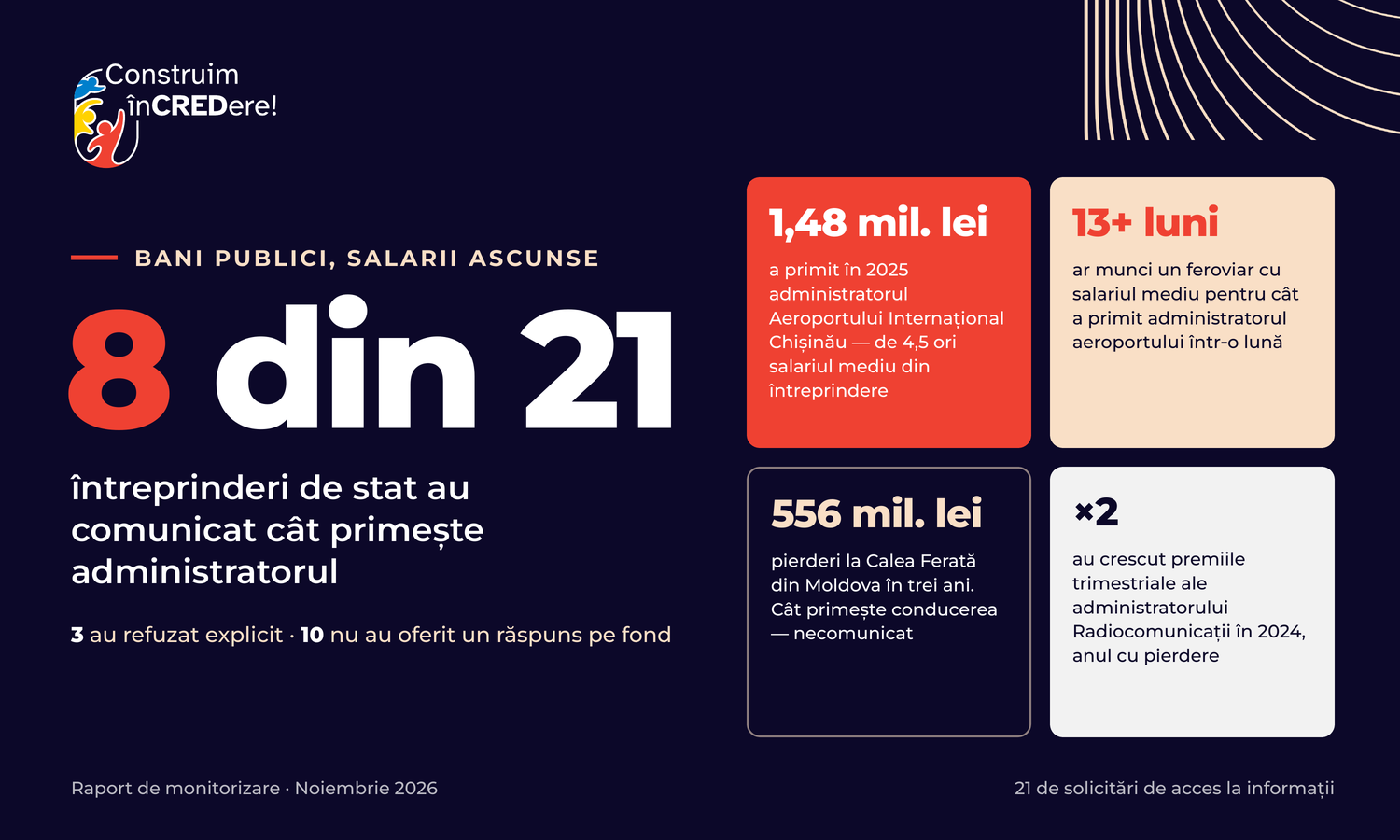
Of the 21 state-owned enterprises we asked, only 8 disclosed how much the administrator is paid. Three refused explicitly, and 10 gave no substantive answer. Where data exist, monthly salaries fall within the legal cap, but bonuses, allowances and one-off payments can double or triple the base salary.
These are the key findings of the monitoring report “Public money, hidden salaries”, prepared by the Civic Movement „Construim ÎnCREDere” (author: Tatiana Crețu). The report shows not only how much is paid, but also how hard it is to find out — even though the law clearly states that this information is public.
How we worked
In August–October 2026, we submitted 21 requests for access to information of public interest, in two waves. The first, on 7 August, went to 9 enterprises and asked for broad data: organisation, financial situation, management remuneration and internal pay regulations. The second, on 2 October, went to another 12 enterprises and focused exclusively on pay and bonuses.
The enterprises were selected from the Public Property Register by size, unusual financial results and the public interest of their activity. The list covers transport, energy, telecommunications, forestry and services. We requested data for 2023–2025.
Remuneration was compared with the caps set by Government Decision No. 743/2002. Conclusions about possible breaches are framed as hypotheses that require verification, not as accusations.
Who answered and who stayed silent
The response rate is itself a finding. Only 8 enterprises disclosed the administrator’s remuneration. Another 3 replied but refused the essential data, and 10 gave no substantive answer.
| Category | Enterprises | Number |
|---|---|---|
| Disclosed remuneration | Radiocomunicații, INGEOCAD, NHE Costești, Hîncești-Silva, Chișinău International Airport, Universul Publishing House, Central Printing House, Indoor Athletics Arena | 8 |
| Refused data on management | Moldelectrica, Ungheni River Port, Moldovan Railways | 3 |
| Requested an extension, no final answer | Mărculești International Airport | 1 |
| Did not reply | Medisan, Chișinău Glass Factory, MoldATSA, Poșta Moldovei, Mileștii Mici Winery, State Forestry Enterprise „Glodeni”, Building Operation Directorate, „Mecagro” Institute, State Service for Project Verification and Expertise | 9 |
The quality of the responses varies widely. Radiocomunicații sent a complete table, by person and component, for three years. The Universul Publishing House and the Central Printing House are the only ones that also sent an extract from the administrator’s contract, with the performance indicators. NHE Costești sent the managers’ asset declarations instead of a breakdown by component.
Chișinău Airport: 1.48 million lei a year
The highest documented remuneration is at Chișinău International Airport. In 2025, the administrator received 1,477,192 lei gross, or about 123 thousand lei a month. That is 4.5 times the enterprise’s average salary of 27,407 lei.
The base salary accounts for less than a third of the total. The rest comes from allowances, bonuses and other payments, including: an intensity allowance of 407,552 lei, an annual production bonus of 199,883 lei, quarterly bonuses, material assistance and a one-off bonus. Almost every component is at the limit of the legal cap.
Two items require explanation:
- The intensity allowance and the quarterly bonuses together reach 122% of the base salary, above the 100% limit set by GD No. 743/2002, if the quarterly bonuses are considered current bonuses.
- The administrator received 73,132 lei in compensation for unused leave, even though he remained in office. The Labour Code allows such compensation only on termination or suspension of the contract.
Between 2024 and 2025, the administrator’s monthly remuneration rose by about 25%, from 98 to 123 thousand lei. Over the same period, the airport’s average salary rose by 2.4%. The airport explains the change by the growth in turnover, from 674 million lei in 2023 to 1.94 billion lei in 2025.
Bonuses unrelated to results
Under the law, bonuses should reward the achievement of performance indicators. The data obtained suggest that, in practice, they work rather as a fixed part of pay.
- Bonuses in a loss-making year. In 2024, Radiocomunicații recorded a loss of 8.87 million lei. In the same year, the administrator’s quarterly bonuses doubled, from 31,850 to 70,707 lei. The law allows the head of a loss-making enterprise to receive a bonus only if losses fall by at least 10%.
- Caps become targets. At INGEOCAD, the administrator’s bonuses totalled exactly 185,000 lei in 2025, or 5.0 base salaries — right at the legal cap. At Chișinău Airport, bonuses and one-off payments reached 4.95 base salaries, against a cap of 5.
- “Performance” allowances for everyone. At Chișinău Airport, all heads of department receive a work-effectiveness allowance of 46–65% of salary. An allowance granted to everyone no longer differentiates performance.
There are counter-examples too. At the Central Printing House, the Public Property Agency cut the administrator’s bonus to 70% of salary, because only 5 of 7 indicators had been met. At the Universul Publishing House, the administrator received no quarterly bonuses — only a single annual reward after a profitable year. The system can work when indicators exist and are checked.
Two state-owned enterprises, two realities
A railway employee on the average salary of 9,279 lei would need more than 13 months to receive what the airport administrator received in a single month of 2025. Both enterprises belong to the state.
| 2025 | Chișinău International Airport | Moldovan Railways |
|---|---|---|
| Net result | profit of 712.0 million lei | loss of 90.0 million lei |
| Cumulative result 2023–2025 | profit | losses of about 556 million lei |
| Average number of employees | 881 | 3,816 |
| Average monthly salary (gross) | 27,407 lei | 9,279 lei |
| Administrator’s remuneration | about 123,100 lei/month | not disclosed |
Moldovan Railways is an enterprise in crisis. Its workforce shrank by 23% in a single year, and at the end of 2025 its wage arrears to staff stood at 99 million lei — almost three months of salaries for the entire enterprise.
The railway says it paid no bonuses to management in 2023–2025. The claim is plausible but cannot be verified: the enterprise did not disclose any amount for the director or deputies.
Years-long interim terms and refusals without grounds
The administrator of a state-owned enterprise must be selected by competition. According to explanations from the Public Property Agency quoted in the press, an interim term is limited to six months, with a single extension. In practice, interim terms have lasted more than five years at the Indoor Athletics Arena, more than four years at INGEOCAD, almost four years at the Universul Publishing House and more than three years at the Central Printing House.
An interim administrator has not gone through a competition and has no contract with negotiated indicators. That makes paying bonuses at the maximum level even harder to justify.
The refusals we received have no solid legal basis:
- “The salary is confidential and guaranteed” — cited by Ungheni River Port. Art. 8(3) of Law No. 148/2023 prohibits restricting access to the remuneration of public agents. Moreover, data on the administrator’s salary had already been published by the port itself, in the State Financial Inspectorate report.
- “The contract is held by the founder” — the answer from Moldovan Railways and Moldelectrica. The amounts actually paid are in the enterprise’s own accounts. And the law requires the request to be forwarded to the founder within five working days — no enterprise did so.
- Silence — 9 enterprises did not reply at all. Failure to answer within the deadline is equivalent to rejecting the request and can be challenged in court within one year.
What we call for
The recommendations are addressed to the institutions that can change practice, not to the people who run the enterprises today.
- The Public Property Agency should publish annually, for each state-owned enterprise, the administrator’s total remuneration by component, together with the performance indicators and the degree to which they were met. It should hold competitions for positions filled on an interim basis beyond the legal term.
- The Government should amend GD No. 743/2002 so that managers’ bonuses are explicitly conditional on public indicators, and initiate legislative changes to make publication of management remuneration mandatory.
- Parliament’s Commission of Inquiry should examine management remuneration at all state-owned enterprises, with a focus on bonuses paid in loss-making years.
- The State Financial Inspectorate should check compliance with bonus caps during its inspections.
- State-owned enterprises should answer requests on time, with data by component, and give reasons for any refusal.
The main problem is not the level of salaries, but the lack of transparency and the weak link between bonuses and results. The money of state-owned enterprises is public money. The remuneration of those who manage it must be public, explainable and linked to results.
The Civic Movement „Construim ÎnCREDere” will continue its monitoring, challenge unreasoned refusals and return with updated data.