

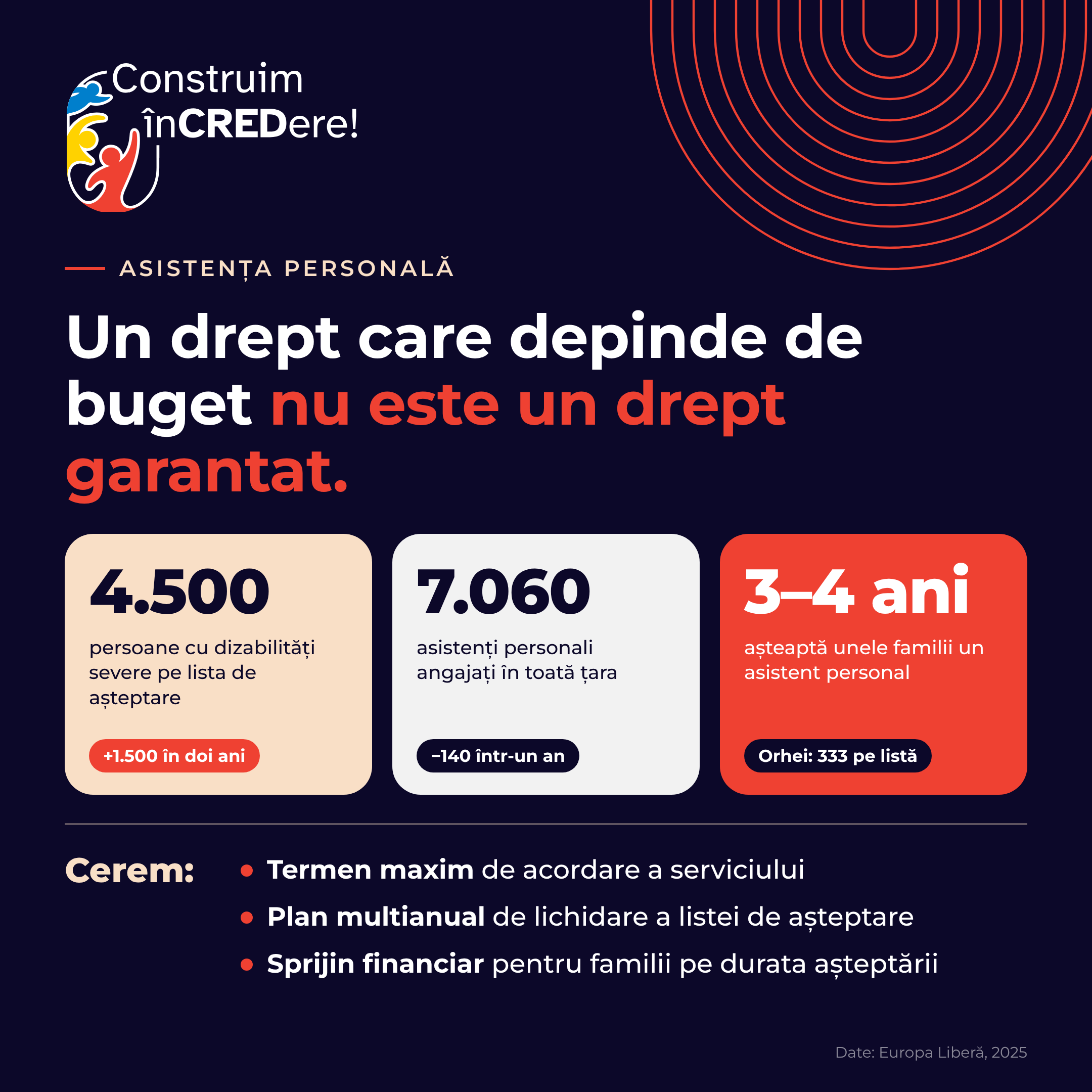
The right to a personal assistant cannot wait four years.
Summary
Under the current legal framework, the “Personal Assistance” social service is a home-based care service intended for people with severe disabilities (Group I). It aims to develop or maintain personal autonomy and prevent institutionalisation.
The Civic Movement “Construim Încredere” believes that a right dependent on the annual budget cannot be considered a guaranteed right. We call for personal assistance to become an effectively enforceable right, with a maximum timeframe for accessing the service, a multi-year plan to eliminate waiting lists, and financial support for families during the waiting period.
Background
In 2025, 4,500 people with severe disabilities were on the waiting list for personal assistance, an increase of 1,500 compared to two years earlier. At the same time, the number of personal assistants fell to 7,060, which is 140 fewer than in the previous year (Europa Liberă).
In some districts, demand exceeds available capacity by more than twofold. In Orhei district, the waiting list grew from 285 people in 2024 to 333 in 2025, while only 197 personal assistants were employed. Some people have been waiting for 3–4 years.
Behind these figures are real families. Recently, a single mother and survivor of domestic violence publicly shared her experience of caring for a child who cannot remain at school for more than a few minutes, while the waiting period to become a personal assistant is 3–4 years. The family is forced to survive on donations instead of receiving a service that the state is legally obliged to provide.